
New Study in China Shows Better Weaning Weights and Fewer Fall-Behinds with Tonisity Px

Another commercial trial conducted in China has added to the growing evidence supporting Tonisity Px in pre-weaning piglets.
At Tonisity, our commitment to measurable, evidence-based results means evaluating product performance under different commercial conditions, countries and production systems. Individual trials provide valuable farm-level insights, while larger analyses help determine whether those results remain consistent across multiple populations.
Product decisions should not rely solely on individual claims or isolated results. They should be supported by clearly defined protocols, appropriate comparisons, statistically analysed outcomes and broader evidence across multiple studies.
This study, 26-041-P-P, conducted on a commercial farm in China, found that Tonisity Px supported higher weaning weights, faster pre-weaning growth and a greater proportion of full-value pigs at weaning.
Study design and farm profile
The study included 1,107 piglets from 96 litters on a 10,875-sow farm. The farm operated a weekly farrowing system, with approximately 12.5 piglets born alive per litter and weaning at approximately 20 days of age.
The Tonisity Px and Control groups were studied at the same time and housed in the same farrowing rooms.
Tonisity Px was administered at:
500 ml per litter per day from Day 2 to Day 8 of life
500 ml per litter per day for three days before weaning, poured onto creep feed
The Control group did not receive any supplementation.
Fall-behinds were defined in this study as piglets weighing less than 6 kg at weaning.
What were the results of using Isotonic Protein for piglets?
Better Pre-Weaning Growth
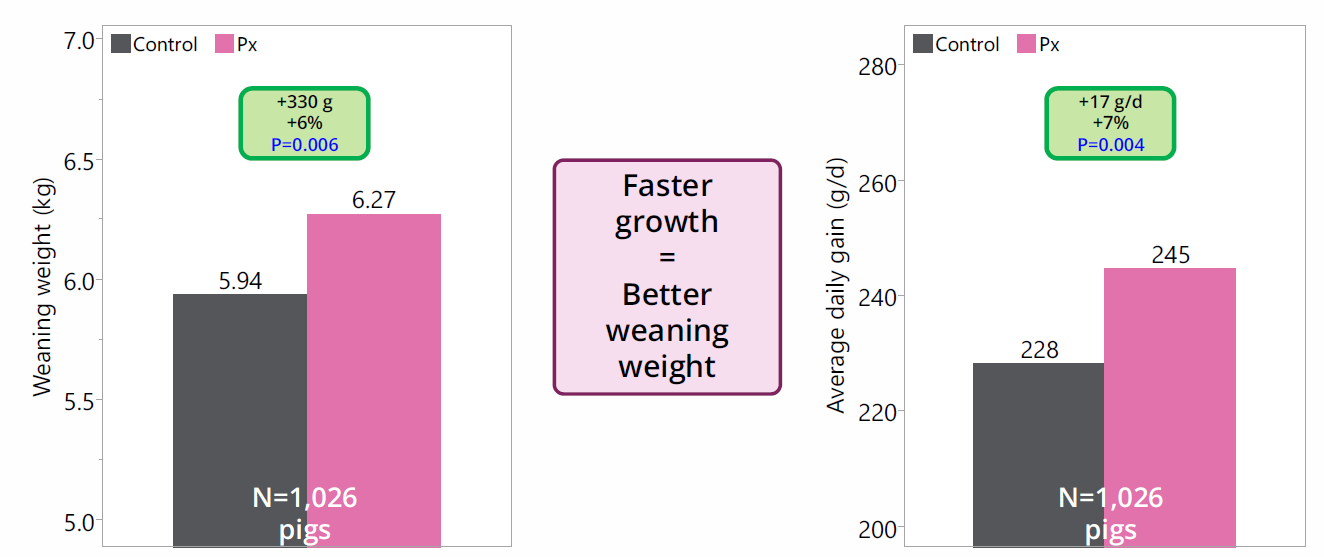
Piglets receiving Tonisity Px achieved faster pre-weaning growth and were heavier at weaning. After accounting for initial piglet weight, average weaning weight increased from 5.94 kg in the Control group to 6.27 kg in the Tonisity Px group.
This represented:
6% heavier piglets at weaning = +330 g in weaning weight
+17 g/day (7%) higher pre-weaning growth (P=0.004)
Growth Across the Whole Population
The distribution of weaning weights shows that the benefit was observed across the entire piglet population, rather than being limited to only the lightest or heaviest animals.
Compared with the Control group, the weight distribution of piglets receiving Tonisity Px shifted towards higher weaning weights. This indicates a broader population-level growth response and fewer piglets remaining in the lower weight range at weaning.
The growth analysis reported data from 1,026 piglets.

Better Quality Pigs
The improvement in growth resulted in a greater proportion of piglets reaching full-value weight at weaning. In this study, fall-behinds were defined as piglets weighing less than 6 kg at weaning.
The proportion of full-value pigs increased from 48% in the Control group to 66% in the Tonisity Px group. At the same time, the proportion of fall-behinds decreased from 52% to 34% (P=0.002).
This represented:
35% fewer fall-behinds
38% more full-value pigs
180 additional full-value pigs per 1,000 piglets weaned

These results show that the benefit extended beyond average body weight, increasing the number of piglets reaching the full-value category at weaning.
How do these findings compare with the wider evidence?
The results are closely aligned with Tonisity’s latest global meta-analyses.
A meta-analysis of 46 studies involving 41,983 piglets found that Tonisity Px increased weaning weight by an average of approximately 300 g, or 5%, at around 23 days of age (P<0.0001). In the Chinese study, the improvement was 330 g, or 6%, at approximately 20 days.
A separate meta-analysis of 29 studies involving 35,643 piglets found a 36% reduction in fall-behinds. Study 26-041-P-P recorded a closely comparable 35% reduction.
Was pre-weaning mortality affected?
No effect on pre-weaning mortality was observed in this study. Mortality was already low on the farm, at 2.2% in the Control group.
Discover Tonisity
Tonisity solutions are distributed in more than 60 countries.
Interested in representing Tonisity in your country?
Frequently asked questions
What was the main result of the Tonisity Px study in China?
Piglets receiving Tonisity Px were 330 g heavier at weaning, grew 17 g/day faster and had 35% fewer fall-behinds than Control piglets.
How many piglets were included in the study?
The total study population included 1,107 piglets from 96 litters. The growth analysis reported results from 1,026 piglets.
How was Tonisity Px administered?
Tonisity Px was provided at 500 ml per litter per day from Day 2 to Day 8, followed by 500 ml per litter per day poured onto creep feed for three days before weaning.
What was considered a fall-behind piglet?
In this study, a fall-behind was defined as a piglet weighing less than 6 kg at weaning.
Are these results consistent with other Tonisity Px studies?
Yes. The 330 g improvement in weaning weight compares with an average improvement of approximately 300 g across 46 studies and 41,983 piglets. The 35% reduction in fall-behinds also aligns with the 36% reduction observed across 29 studies and 35,643 piglets.
What were the results of using Tonisity Px for piglets?
330 g higher weaning weight, equivalent to a 6% improvement
17 g/day higher pre-weaning average daily gain
35% fewer fall-behinds
180 additional full-value pigs per 1,000 piglets weaned
Average weaning weight increased from 5.94 kg in the Control group to 6.27 kg in the Tonisity Px group (P=0.006).
Average daily gain increased from 228 g/day to 245 g/day (P=0.004).
Study reference: Tonisity Study 26-041-P-P, China, 1,107 piglets from 96 litters.


Comments